 An artist’s journey through art, history and the moments that quietly transformed my life.
Roma
There are moments in life that seem ordinary when they happen.
Only years later do we realise they quietly changed everything.
For me, one of those moments began in Rome.
At the time, I was studying at Goethe University in Frankfurt, where art history formed an important part of my academic journey.
As part of our programme, our professor took us to Rome to study directly in front of original masterpieces.
It was an extraordinary privilege. We were given access to places that are normally closed to the public, allowing us to experience works of art in a way that few people ever can.
Rome soon became my university beyond the university.
Our lectures filled the days, but the nights belonged to discovery.
Rome never truly slept, and neither did we.
After classes we disappeared into its streets, wandering from churches to museums, from lively cafés and restaurants to small bars and clubs hidden among ancient buildings.
We talked, laughed, argued about art and philosophy, and walked until the first light of morning.
Looking back, I realise that I was not only studying art—I was learning how to live with it.
It was there that I truly met Caravaggio.
I visited every painting of his that I could find.
Yet one remained with me more deeply than all the others.
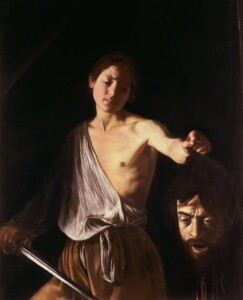
David with the Head of Goliath.
I still remember standing before it in complete silence.
David looked at me in a way I cannot fully explain even today.
I felt sorrow, tenderness, hope and compassion all at once.
Goosebumps covered my skin.
For a brief moment, time seemed to disappear.
It felt as though Caravaggio had left something of himself within that painting.
I left Rome carrying that feeling with me.
Without realising it, I carried it for many years.
Life led me in another direction.
After returning to Germany, I completed my studies and devoted myself to building a business. Then, after suffering a stroke, I realised how fragile time truly is.
I made a promise to myself.
If life had given me another chance, I would spend it doing what I loved most.
I chose painting.
I opened my atelier, Secret Art Place.
It was never intended to become a gallery.
I simply wanted to create a place where artists, poets, musicians and thinkers could meet.
A place where philosophy could meet art, where exhibitions would invite dialogue rather than simply display paintings, and where creativity could give a voice to those who are too often unheard.
Slowly, without my ever planning it, my atelier became a gallery.
Perhaps it had always been meant to.
Then, many years after my first encounter with Caravaggio in Rome, something happened that I could never have imagined.
Caravaggio returned.
Not through another museum.
Not through another book.
But through a painting discovered in my native Poland.
And that is where this story truly begins…
Monaco.
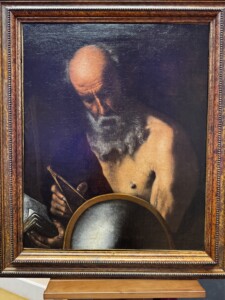
Eighteen years after I first fell in love with Caravaggio’s art in Rome, life brought him back to me in the most unexpected way.
After the painting was recognised as a work by Caravaggio, with evidence pointing to a collaboration with his close friend and fellow painter Mario Minniti, I felt that this remarkable discovery deserved to be presented to the world. Together with its discoverer, Adrian Alexander Romanov, I co-organised an international symposium in Monaco, bringing together leading historians, researchers, curators and art experts to discuss what many considered one of the most remarkable art discoveries in recent years.
What began as admiration for one of history’s greatest painters had slowly become an extraordinary journey—one that led me back to Caravaggio in a way I could never have imagined.
For months, my life revolved around a single date.
Every morning began with another list of things that still had to be done, and every evening ended with new ideas, new corrections and new conversations. Invitations took shape. Biographies found their final words. Exhibition texts were rewritten again and again. Programmes evolved, presentations grew, graphics slowly came to life, and even the smallest details demanded attention.
There were moments when I felt as though I was living in two worlds at once.
One was practical, filled with emails, phone calls, deadlines and endless decisions.
The other belonged entirely to art.
Somewhere between those two worlds, the symposium was quietly being born.
As Monaco drew nearer, everything seemed to move faster. Guests had to be welcomed at the airport, last-minute changes appeared without warning, and even the journey became part of the adventure. Roads were closed because of the Monaco Grand Prix , schedules changed from one moment to the next, and for a while it felt as though everything was happening at once.
It was beautiful chaos.
And somehow, piece by piece, everything found its place.
When I finally arrived, the stress simply disappeared.
Monaco welcomed us with elegance, generosity and a genuine sense of purpose. From the organisers to the volunteers, everyone seemed to understand that this gathering was about something larger than a conference.
For me, Monaco was the perfect place to honour Caravaggio.
Not because of luxury, but because history, beauty and culture seemed to exist there in perfect balance.
The symposium became much more than an academic event.
It brought together historians, researchers, curators, artists and collectors from different countries, speaking different languages yet connected by one shared passion.
Caravaggio.
There was another moment I will never forget.
Standing before the painting, I experienced something strangely familiar.
The goosebumps I had felt eighteen years earlier in Rome, while standing before David with the Head of Goliath, quietly returned.
It was not the same place.
It was not the same painting.
Yet the feeling was unmistakable.
Throughout the symposium I spoke with historians, researchers, curators and guests from many countries. Again and again, I heard remarkably similar reflections.
“There is something about this painting.”
Everyone described it differently, yet they all spoke of the same quiet certainty that they were standing before something extraordinary.
Those conversations did not tell me what to think.
They reminded me of what I had already felt years before.
Perhaps that is one of Caravaggio’s greatest mysteries.
More than four hundred years later, his art still brings people together, inspires dialogue and awakens emotions that words can never fully explain.
As the lectures ended and dinner began, the conversations continued late into the evening. Ideas were exchanged, friendships were formed and new collaborations quietly began.
Looking back today, I realise that Monaco gave me far more than memories of a remarkable symposium.
It gave me extraordinary people.
And that is what I carried home with me.
But the story does not end in Monaco.
In many ways, it has only just begun.
My next journey will take me to Malta, one of the most important places in Caravaggio’s final years. There, I hope to follow the traces he left behind, to walk through the places connected with his life, his exile, his struggle and his art.
I want to understand not only the painter admired by history, but the man behind the legend.
Caravaggio continues to lead me from one place to another.
From Rome to Monaco.
And now, to Malta.
the journey continues…
It has been a great honour to become part of this remarkable project and to work closely with Dr. Roberta Lapucci, Dr. Alessandra Gregori, Dr. Barbara Savina, Dr. Fabio Scaletti, and Jovan and Gabi Mizzi from the Caravaggio Foundation in Malta, together with many other wonderful researchers, historians and friends who have dedicated their lives to preserving Caravaggio’s legacy.
Beyond the research itself, I discovered something equally valuable — extraordinary people united by a shared passion for art, history and the search for truth.
This is only the beginning of my own journey following in Caravaggio’s footsteps.
Who could have imagined that, after so many years, Caravaggio would return to my life in such an unexpected way?
Perhaps some journeys choose us long before we realise they have begun.
Interview with Dr. Roberta Lapucci during the Monaco Symposium.
If you would like to learn more about the research, the painting, or the story behind this extraordinary discovery, I warmly invite you to visit the official project website:
https://www.thecaravaggio.com/
If you would like to know more about the discovery, the research, or my own journey connected with this project, I would be delighted to hear from you.
Whether you are a collector, journalist, researcher or simply someone fascinated by Caravaggio, feel free to get in touch:
http://mailto :kontakt@katharinarubinart.com
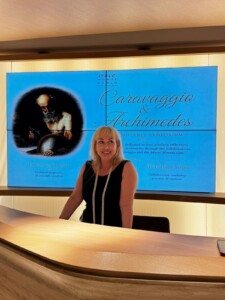
Monte carlo 2026
My journey with Caravaggio has only just begun…